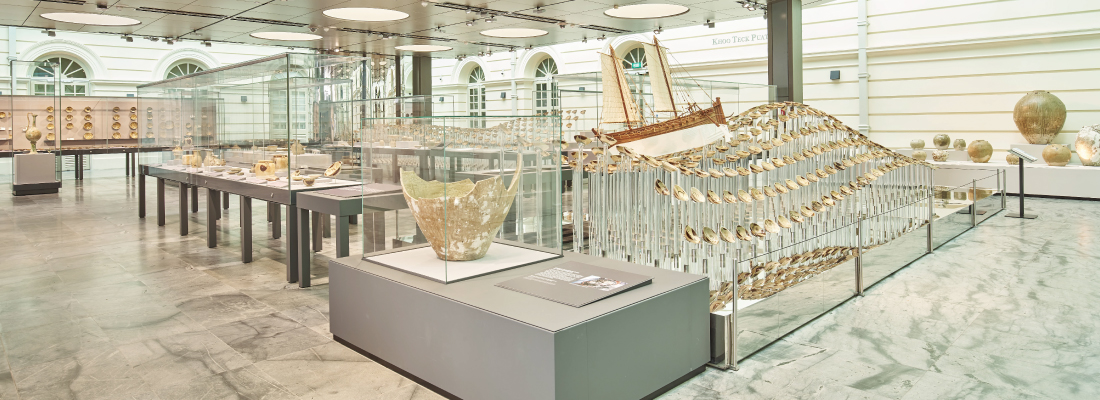
Object Name: Tang Shipwreck Collection (also known as the Belitung Shipwreck Treasure or Tang Treasure)
Object Type: Archaeological cargo assemblage – includes ceramics, precious metalware, bronze mirrors, glass, stone, organic materials, and ship timbers
Materials: A highly diverse assemblage: glazed stoneware (Changsha ware, Yue celadon, Ding and Xing wares), bronze, silver, gold, lead, glass, stone, wood, resin, spices and more
Dimensions: The shipwreck held approximately 60,000 objects, including ~56,000 Changsha ware ceramics; non‑ceramic objects numbered ~6,000 Individual objects vary widely—for example, a gold octagonal cup height ~9 cm; a bronze mirror
Culture Origin: Tang dynasty, China (ca. 825–850 AD). Traded via Srivijayan/Arab merchant networks; with objects from kilns in Hunan (Changsha), Henan (Xing), Zhejiang (Yue), plus West Asian and Southeast Asian origins
Inscriptions: Some ceramics bear inscriptions—for example, one Changsha bowl is dated “16th day of the seventh month of second year of Baoli reign” (826 AD). Bronze mirrors include dated inscriptions such as “29th day of the 11th month of the first year of Qianyuan re
Exhibition: Debuted publicly at the ArtScience Museum, Singapore from February 19 to July 31, 2011, under the exhibition Shipwrecked: Tang Treasures and Monsoon Winds
Condition: Generally well‑preserved despite saltwater exposure. Ceramics survived in complete condition; corrosion and concretion affected metals and organics. Overall condition is considered good following extensive desalination and conservation
Conservation History: Salvage conducted in 1998–1999 by Seabed Explorations NZ Ltd, followed by scientific desalination, stabilization, and documentation in New Zealand. Purchased in 2005 by Sentosa Leisure Group and Government of Singapore, then loaned to Singapore Tourism Bo
Preservation Status: Conserved and managed by Asian Civilisations Museum; displayed permanently in Khoo Teck Puat Gallery since 2015
Preservation History: Excavated from Belitung wreck in 1998; acquired by Singapore in 2005; first displayed in Museum in 2011 at ArtScience Museum, then permanently housed since 2015
Retention Policy: Permanent collection
Archival Location: Asian Civilisations Museum, Singapore
Backup Status: Physical artifacts; digital photographic/documentation archives maintained
Parent Collection: Asian Civilisations Museum - Maritime heritage and global trade artifacts collection
Sub Collections: Tang Shipwreck Treasure / Maritime Silk Road Gallery
Related Items: Archaeological wreck documentation, Jewel of Muscat replica ship, exhibition catalogs (e.g. Shipwrecked: Tang Treasures and Monsoon Winds)
Accessibility Features: Not specified
Accessibility Compliance: Not specified
Copyright Status: Public domain (Tang Dynasty materials)
Copyright Holder: None
License Terms: Museum holds collection under heritage stewardship; display subject to institutional policies and museum rights
Jurisdiction: Singapore
Cultural Significance: Cultural Significance: Represents one of the largest Tang Dynasty export cargoes ever discovered; significant for understanding maritime trade between Tang China, Southeast Asia, and the Abbasid Caliphate
Cultural Context: Highlights trade exchange, cultural syncretism, technological exchange, and consumption patterns of 9th‑century global trade
Access Statistics: Attracted over 150,000 visitors during initial exhibitions; continues to be a major draw at ACM
Citation Information: Tang Shipwreck Treasure: Singapore’s Maritime Collection; Asian Civilisations Museum; National Heritage Board, Singapore; exhibition catalogs and ACM publications
User Feedback: Widely acclaimed internationally; praised for heritage value and historical significance
Educational Use: Illustrates maritime archaeology, global trade networks, and cross‑cultural interactions during the Tang era
Curriculum Alignment: Maritime history, Silk Road studies, ancient trade and economics
Learning Objectives: Learn about the Belitung wreck discovery, Tang‑period export ceramics, gold luxury wares, and the role of Singapore as a heritage steward